A wooden façade made of larch and thermally modified timber: how it ages and how to look after it
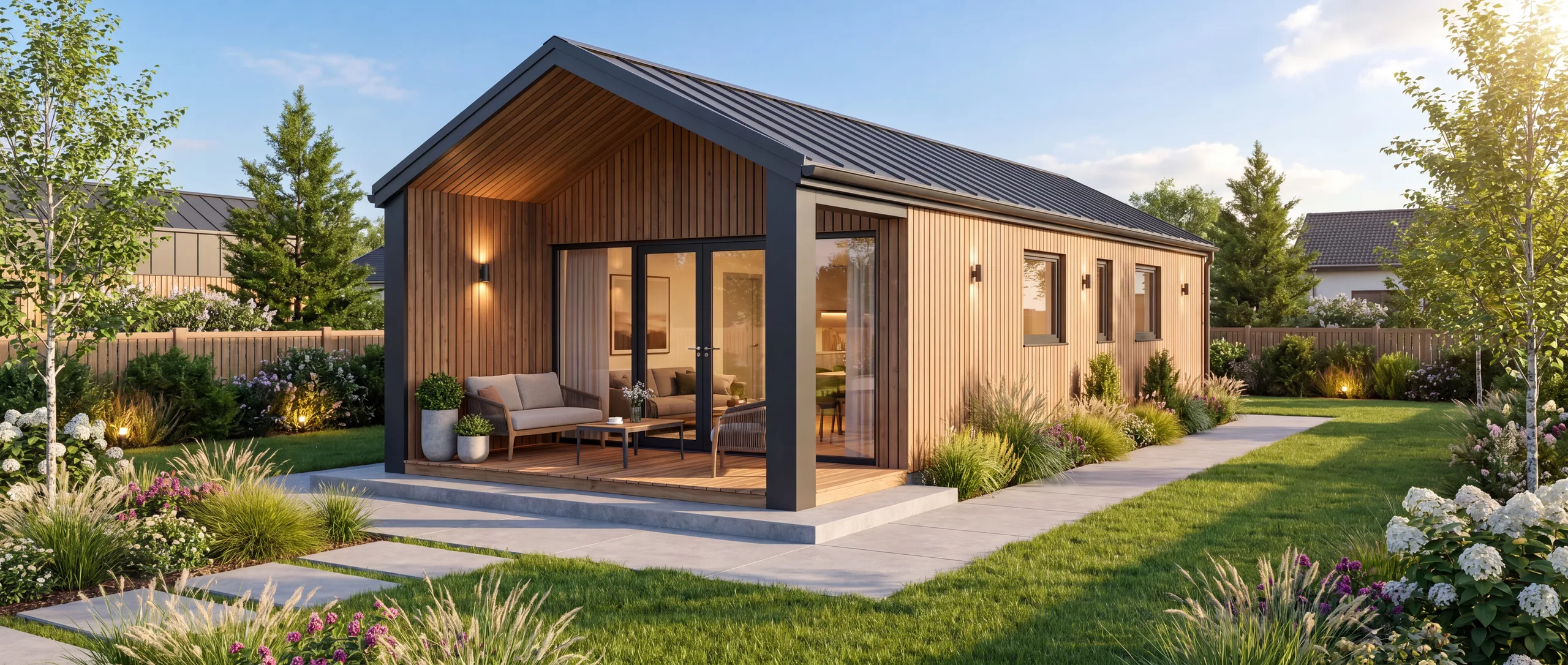
Wooden cladding gives a house character, but outdoors it is exposed to the sun, rain and wind. If you choose wooden cladding from us, in accordance with our standards it will be larch cladding from the ‘THERMOWOOD Rhombus’ Premium range (thermally modified timber). We’ll explain why wood changes colour, how thermally modified timber differs from ordinary wood, what determines the lifespan of the façade, and when and how to treat it. We draw primarily on peer-reviewed specialist articles on TZB-info (Ing. P. Ptáček, CTU UCEEB; Doc. J. Solař, VŠB-TU Ostrava; Ing. R. Milič), on publications by the Austrian timber association proHolz and the Holzforschung Austria research institute, and on the handbook of the International ThermoWood Association.
What types of timber façades do we build?
In the ŠVEMAWOOD standards, timber cladding is used on the façades of all three types of buildings:
Prefabricated houses: Economy ‘Facade render (100 mm EPS 70F external insulation) or larch cladding’, Komfort ‘EPS 70F (120–180 mm) or wood fibre board + larch cladding’, Premium “THERMOWOOD Rhombus or rebated aluminium sheet”.
Modular houses: Economy “Facade plaster or larch cladding”, Komfort “Plaster or larch cladding with wood fibre board”, Premium “THERMOWOOD Rhombus or rebated aluminium sheet”.
Tiny House: in the description of the load-bearing structure, Economy: ‘20 mm external larch cladding’, Komfort: ‘20 mm larch cladding’, Premium: ‘THERMOWOOD Rhombus façade or folded aluminium sheet’.
In the Economy and Komfort ranges, the timber façade is made of larch; in the Premium range, the specifications state ‘THERMOWOOD Rhombus’. We explain what the terms THERMOWOOD and Rhombus mean below. Instead of timber, the specifications for some ranges also list other options: render for Economy prefabricated and modular houses and for Komfort modular houses, and rebated aluminium sheeting in the Premium range for all three types of building. This article focuses on the timber options.
Larch is a native coniferous timber species. According to the European standard ČSN EN 350, as cited in a peer-reviewed article on TZB-info, larch has a natural resistance to wood-destroying fungi in class 3–4 (by comparison, spruce is in class 4), on a scale ranging from 1 (highly durable) to 5 (non-durable). The sapwood of all timber species is non-durable. Furthermore, the classes according to EN 350 are based on tests of timber in contact with the ground, so they do not directly predict the service life of cladding. Even larch is not indestructible, and structural protection and careful attention to detail play a major role.
Why does timber turn grey outdoors?
Greying is a natural process, not a defect in the timber. It is triggered by sunlight, but the resulting grey colour is also influenced by dust and microorganisms, including moulds and fungi, which discolour the timber. Associate Professor Jaroslav Solař from VŠB-TU Ostrava describes it as follows: UV radiation ‘causes the wood surface to turn grey’, because the surface layers containing lignin are transformed into substances that can be washed away by water. An article by Ing. Richard Milič adds that the degradation of lignin leads to a loss of cohesion in the wood mass on the surface. According to Gerhard Grüll from the Austrian research institute Holzforschung Austria, moulds and fungi that merely discolour the wood do not decompose it: they do not reduce its strength or durability.
Untreated wood changes rapidly on a façade. According to proHolz, all types of wood without a surface treatment take on a similar appearance after about a year of exposure to the elements. Ing. Petr Ptáček from ČVUT UCEEB, referring to untreated Siberian larch, states that “the façade retains its original appearance for about half a year, after which it begins to turn black”. If you wish to maintain the colour of the façade, you should plan from the outset to use a pigmented coating and to renew it. It is practically impossible to preserve the wood’s original colour in the long term.
Thermally modified timber (in accordance with THERMOWOOD standards)
ThermoWood® is a registered trademark of the International ThermoWood Association (ITWA). It refers to an industrial process developed by the Finnish research centre VTT in collaboration with timber companies. According to the ITWA, the process involves treating the timber at elevated temperatures in the presence of steam and at atmospheric pressure, without the addition of chemicals. The general term for such a material is thermally modified (heat-treated) timber. The following information from the ITWA applies to ThermoWood® produced by its members, as only they are authorised to use the trademark. Specifications may vary for other types of thermally modified timber, so please check with your specific supplier.
The changes in the timber are permanent. According to the ITWA handbook from 2025, such timber swells and shrinks less, is more dimensionally stable, more biologically resistant, darker throughout its cross-section and contains no resin. It is not intended for load-bearing structures.
Two grades. The ITWA distinguishes between Thermo-S (stability) and Thermo-D (durability). For Thermo-S, pine and spruce are treated at 190 °C; for Thermo-D, at 212 °C. According to the ITWA, Thermo-S is mainly suitable for interior use, for furniture, in saunas and for outdoor elements with minimal exposure to the elements. Thermo-D is intended for demanding outdoor conditions, including, amongst other things, external cladding and decking. The handbook recommends the Thermo-D class for façade cladding.
Durability. According to the ITWA, the Thermo-D class is intended to provide higher resistance to rot and weathering. The current ITWA handbook from 2025 does not specify a particular durability class. According to the handbook, resistance is determined by laboratory tests in accordance with standards. The ThermoWood handbook does not recommend its use for structures in direct contact with the ground or water.
Even ThermoWood turns grey. According to the ITWA handbook, UV radiation causes untreated timber products to turn grey, even in the case of thermally modified timber. Mould may also appear on untreated surfaces. However, this is only superficial and can be wiped or scraped off. A review article in the peer-reviewed journal Forests (2021) describes a two-year experiment in Ljubljana, Slovenia, involving thermally modified timber (a different commercial process to ThermoWood). In the study, the treated timber changed colour less overall than the untreated timber, but it turned grey more quickly. The dark brown hue of ThermoWood therefore does not last outdoors without a coating.
How to care for ThermoWood. The ITWA recommends applying a surface finish to products exposed to the elements. This helps to preserve the original colour and minimise cracking and splintering of the timber. Similar products to those used on ordinary timber (paint, varnish, oil, wax), whether water-based or solvent-based, can be used. However, there are a few exceptions: due to ThermoWood’s acidity and low absorbency, not all coatings adhere well (this mainly applies to certain water-based products); ITWA therefore recommends consulting the manufacturer when selecting a coating; linseed oil is not suitable for ThermoWood, as, according to ITWA, it promotes fungal growth; cut ends must be treated with an end-sealant; due to the wood’s acidity, fasteners must be made of stainless steel (class A2 or A4); other metals react with ThermoWood and cause discolouration of the wood around the joint.
Rhombus profile. Rhombus slats have a trapezoidal cross-section with sloping sides. They are installed with a narrow visible joint, either using visible screws or concealed clips. Some clips also raise the slats off the substrate to allow the cladding to be ventilated from behind. The ITWA guide generally states that air must always be able to circulate behind ThermoWood external cladding and that all fastenings must be made of stainless steel. You should therefore check this when using clips. Our standards do not specify a particular manufacturer of thermally modified timber or a specific timber species. If you are interested in these details, please ask for a consultation.
Structure first, then coating
Coating is only the second line of defence. A peer-reviewed article on the protection of timber in exterior applications clearly states that structural protection takes precedence over chemical protection and that chemical protection ‘should definitely not replace structural protection’. What this means in practice:
Roof overhang. For houses with timber cladding, Dr Solař recommends a sufficient roof overhang to protect the cladding as much as possible.
Clearance from the ground. Timber elements should be at least 300 mm above ground level. Keep this in mind even when carrying out subsequent alterations to the garden and terraces.
Correct cladding joints. For horizontal cladding, it is essential to prevent rainwater from penetrating the joints. It is better not to design horizontal surfaces at all where water may pool.
Ventilated cavity. There should be a ventilated layer behind the cladding to wick away moisture. According to peer-reviewed articles from Brno University of Technology, a ventilated cavity influences the moisture and temperature behaviour of the structure and effectively draws moisture away from the building envelope.
Each side of the house ages differently. According to Ing. Milič, the southern side receives the most sunlight, the western and eastern sides less, and the northern side the least. On the north side, however, surfaces remain damp for the longest time, and algae and moss may grow there. The paint is therefore subjected to the greatest strain on the south side, and to a lesser extent on the west and east sides.
Let it weather or paint it?
The unpainted option. Mr Ptáček also mentions the option of leaving the Siberian larch façade untreated. This is the solution requiring the least work, but you must accept that the appearance will change significantly during the first year and will not be uniform across the entire façade. The weather does not affect every side of the house in the same way, and according to Holzforschung Austria, a uniform silver-grey colour often only stabilises after several years.
Wood stains and oils. If you wish to preserve the colour, you will need to factor in the need to reapply the coating. Mr Ptáček also points out that coating entire façades does not appear to be a suitable option from a maintenance perspective, and that any maintenance of a timber façade covering the entire house is relatively labour-intensive. Approximate service life of coatings according to Ing. Milič: colourless, pure oil-based glaze – several months; pigmented oil-based glaze – about one year; pigmented alkyd glaze – 3 to 5 years; glaze based on special alkyds with UV absorbers – even more than 10 years. With synthetic glazes, coatings are renewed approximately once every 3 to 5 years; with genuine oil-based glazes, usually every year. According to proHolz, the actual renewal interval depends on the condition of the specific façade.
Ing. Milič provides these figures generally for wood, not for thermally modified wood. For ThermoWood, the exceptions listed above by the ITWA apply: linseed oil is unsuitable, and it is advisable to consult the paint manufacturer regarding the choice of coating. For other types of thermally modified wood, check the procedure with your supplier.
Two practical rules from the same sources. Colourless coatings do not belong on a façade — purely transparent coatings are not suitable for unprotected exteriors; according to Ing. Milič, a darker coating provides better protection, and sufficient thickness ensures long-term protection. A thin coat is easier to renew — with thin-film glazes, according to Ing. Ptáček, you can wait until the glaze has ‘weathered’ and then apply another coat, whilst thicker layers require sanding, which is technically demanding when applied to an entire façade.
Pressure impregnation with coloured oil. Mr Ptáček also describes timber which, before being used on the façade, is pressure-impregnated with a copper-based preparation and then pressure-soaked with coloured oil (he cites pine as an example). In his view, this is probably the most advantageous solution if you want a long service life with minimal maintenance. The disadvantage is a more limited choice of colours. The surface also gradually becomes rough, but it can be repainted with a roller without sanding.
What to look out for when painting
Paint both sides of the cladding boards. If the cladding is painted only on the outside, the boards will warp.
Sufficient thickness. For thin-film water-based wood stains, the minimum thickness is around 75 µm (0.075 mm), which corresponds to at least three well-applied coats. One or two coats applied with a brush are insufficient.
Rounded edges. The required coating thickness is maintained on edges with a radius of at least 3 mm.
Treated cut surfaces. Cross-sections must be sanded and treated with a product designed for end-grain surfaces.
Beware of resin. In resinous woods, such as larch and even spruce, resin may seep out. The resin must be washed out with a suitable solvent before coating, otherwise the coating will fail in those areas.
Stainless steel fastenings. Fasteners should be at least galvanised, preferably stainless steel. According to Mr Milič, even galvanised screws do not last long when exposed to the elements, and rusty water running down the surface will spoil the appearance of the façade. With ThermoWood, fasteners must always be made of stainless steel (A2 or A4). When selecting a specific coating, ask whether it has been tested in accordance with the ČSN EN 927 series of standards.
A simple annual façade inspection
Walk round the house and compare the south and north sides — where the coating is fading or becoming powdery, prepare to repaint. Look for flaking paint and cracks; the best time to repaint is when the coating is completely degraded and cracks are appearing in the timber. On the north side, check for algae and moss. Check the plinth: has the ground risen, and is water from the guttering or paving splashing onto the cladding? Inspect the flashings and guttering above the cladding to ensure there are no leaks.
We’re here for you even after handover
ŠVEMAWOOD’s additional services include ‘Facades, thermal insulation and blown-in insulation’. After the handover, we remain available even after you’ve moved in, and our service and advice are available even after completion. If you’re still planning your timber-frame house, we’ll discuss the type of façade during a free, no-obligation consultation. We’ll get back to you within 48 hours. Telephone +420 733 703 605, email svejdikmartinjob@gmail.com.